China · How to value it
Is my vintage china valuable? Flip it over first.
Grandma's dishes, a thrift-store teapot, a stack of saucers from an estate sale: they all start with the same move. Turn it over, read the mark, then check the rim and the trim before you look up a single price.
The short answer
Usually less than you'd hope, because vintage dish sets can be hard to sell. What moves the number is the maker, the pattern, the age, the condition, how complete the set is and whether anyone is hunting for it right now — and you can check most of that at your kitchen table.
Is my china worth anything?
Some of it is. A lot of everyday 20th-century dinnerware sells for little, even in spotless shape — Kovels notes that plenty of downsizers learn the hard way how tough dish sets are to sell. Six things move the number:
- Maker. A known factory with a clear mark beats an unmarked plate.
- Pattern. Some patterns have buyers trying to finish a set. Others have none.
- Age. Older isn't automatically better, but the mark can tell you roughly when it was made.
- Condition. Chips and cracks knock a piece out of the running. Wear knocks the price down.
- Completeness. Matching place settings and serving pieces help, but a service for twelve needs a buyer with room for it.
- Demand. What someone will pay this year — not what it cost new, or what it means to your family.
How do you read vintage china marks? Flip it over
The backstamp — the printed, stamped or painted mark underneath — is your best first clue. As art-forgery expert Curtis Dowling told CNBC, “the maker's mark will give you almost everything.”
The flip-it-over checklist
- A maker's name, initials or logo. Write it down exactly, then look it up by name at Replacements or in Kovels' marks guides.
- A country name on its own, like “England.” The McKinley Tariff required imports from March 1, 1891 to be marked in English with their country of origin. With very few exceptions, “England” doesn't appear on marks before 1891.
- “Made in England.” Later still — it generally shows up from about 1914.
- “Nippon.” Japanese for “Japan.” Kovels dates Nippon porcelain to 1891–1921; after that, pieces bound for the U.S. read “Japan” or “Made in Japan.”
- “Occupied Japan.” Made for export during the Allied occupation, 1945–1952. “Made in Occupied Japan” was required from February 1947 to August 1949; after that, plain “Japan” was allowed too.
- “Ltd.” or “Limited.” An English firm name from after 1861 — and most are much later.
- “Rd No.” with a number, or a diamond-shaped mark. An English design registration: numbers from 1884, the diamond before that. The date is when the design was registered, not when your plate was made.
- “Bone China.” Those words don't appear in marks until about 1915.
- “Dishwasher proof” or “Microwave safe.” Kovels puts those after 1955 and after 1970 — a sign the piece is newer.
- A pattern name, or just a painted number. A name makes lookups easy. Plenty of 20th-century factories used a number, or nothing at all.
Two cautions
- Dates are a floor, not a ceiling. Kovels says a term's date tells you the earliest it may appear, not how recently it was used.
- Famous marks get copied. Kovels points to the old Royal Vienna beehive shield, copied by many other companies to make their porcelain look more desirable. And because “Nippon” pieces tend to bring more than “Japan” pieces, fake Nippon marks exist too.
Is it bone china, hand-painted or printed?
- Bone china lets light through. Hold a cup up to a lamp with your hand behind it. Bone china is defined by its translucent body, and the modern version dates to Josiah Spode in the early 1790s.
- Printed feels even. Painted doesn't. Run a fingertip over the decoration. Dowling's rule: transfer printing feels even, and on hand-painted work you can feel the brushstrokes.
- Transferware can't date itself. Transfer printing took off in England from the 1750s and put patterns like Blue Willow on everyday pottery. Willow caught on in the late 1700s and is still made today, so the pattern alone can't tell a two-century-old plate from a newer one. The backstamp can.
How to tell if china is valuable: check the condition
Condition is where most hopeful values fall apart. Replacements, the big North Carolina china-replacement company, won't buy anything chipped, cracked, stained, repaired or altered — and it marks its own worn pieces down 25%, 50% or 75% depending on how much wear shows. That's a real market grading scale, in plain numbers.
The condition checklist
Good light, and a towel under the piece.
- Chips. Run a fingertip slowly around the rim, the foot ring underneath, the handle and the spout.
- Hairline cracks. Tilt the piece under a bright light and look for a fine line running in from the edge. Then balance a plate on your fingertips and flick the rim with a fingernail: intact ceramics usually ring clear, while a cracked piece often sounds dull or cut short. A ring is a good sign, not a guarantee.
- Crazing. A spiderweb of tiny cracks in the glaze. It can form as a piece cools after firing or years later, so it isn't proof of age — and dirt that works into it can't be cleaned out.
- Utensil marks. Gray scratches across the middle of a plate from knives and forks. Replacements counts surface scratches as wear.
- Gold or platinum trim wear. Look along rims and handles for trim that's thin, patchy or gone.
- Dishwasher and microwave damage. Dishwasher prongs can scratch china, drying-cycle heat can loosen trim until it wears away, and metallic trim should never go in a microwave.
- Stains and repairs. Brown lines in crazing, a glued handle, a spot that's been painted over. All of them count against a piece.
How do I find out what pattern my china is?
Start with the free tools.
- Photograph the front and the backstamp in good light.
- Try Replacements' Identification Tool. Tap the pink camera icon in their site's search bar and snap or upload a photo.
- If it misses, send it to their researchers. The Pattern Identification Form takes photos, and identification is free. Mail works too; allow 3–5 days once your letter arrives.
- No pattern name on the back? That's normal. Lots of 20th-century factories tracked patterns by number, or didn't mark them at all. Search the maker plus a plain description — shape, colors, trim — and compare photos.
- Missing a piece? Replacements' free “Find This For Me” service emails you when a piece in your pattern comes in.
How much is my china worth? Look at sold prices
A price tag is an asking price. It tells you what one seller hopes to get, not what the piece is worth. Sold prices tell you what buyers actually paid.
- Search sold listings. eBay's own pricing help says to use Advanced Search and choose Completed listings. Count only the ones that sold, and match maker, pattern and the exact piece — a dinner plate is not a salad plate.
- Read Replacements' prices for what they are. The prices on its pattern pages are what it costs to buy a replacement piece. When Replacements buys, it sends a separate Offer to Purchase.
- Know which value you're hearing. Antiques Roadshow separates auction, retail and insurance (replacement) values, and says an auction price can often be half the retail value. The IRS defines fair market value as what a willing buyer and a willing seller agree on, and says an insurance appraisal reflects replacement cost instead.
- Need a number on paper? For insurance, an estate or a donation, hire a qualified personal-property appraiser. The American Society of Appraisers, the International Society of Appraisers and the Appraisers Association of America all run find-an-appraiser directories.
Shopping instead of selling? If you love it and the price feels fair to you, that's the only valuation you need.
Where to find vintage china at the mall
China turns up all over the place here. Carson Antiques & Collectibles Mall is a multi-vendor mall: over 21,000 square feet of numbered booths on two floors, each stocked by a different vendor. A teacup can sit two shelves from a hubcap, and your pattern might be upstairs.
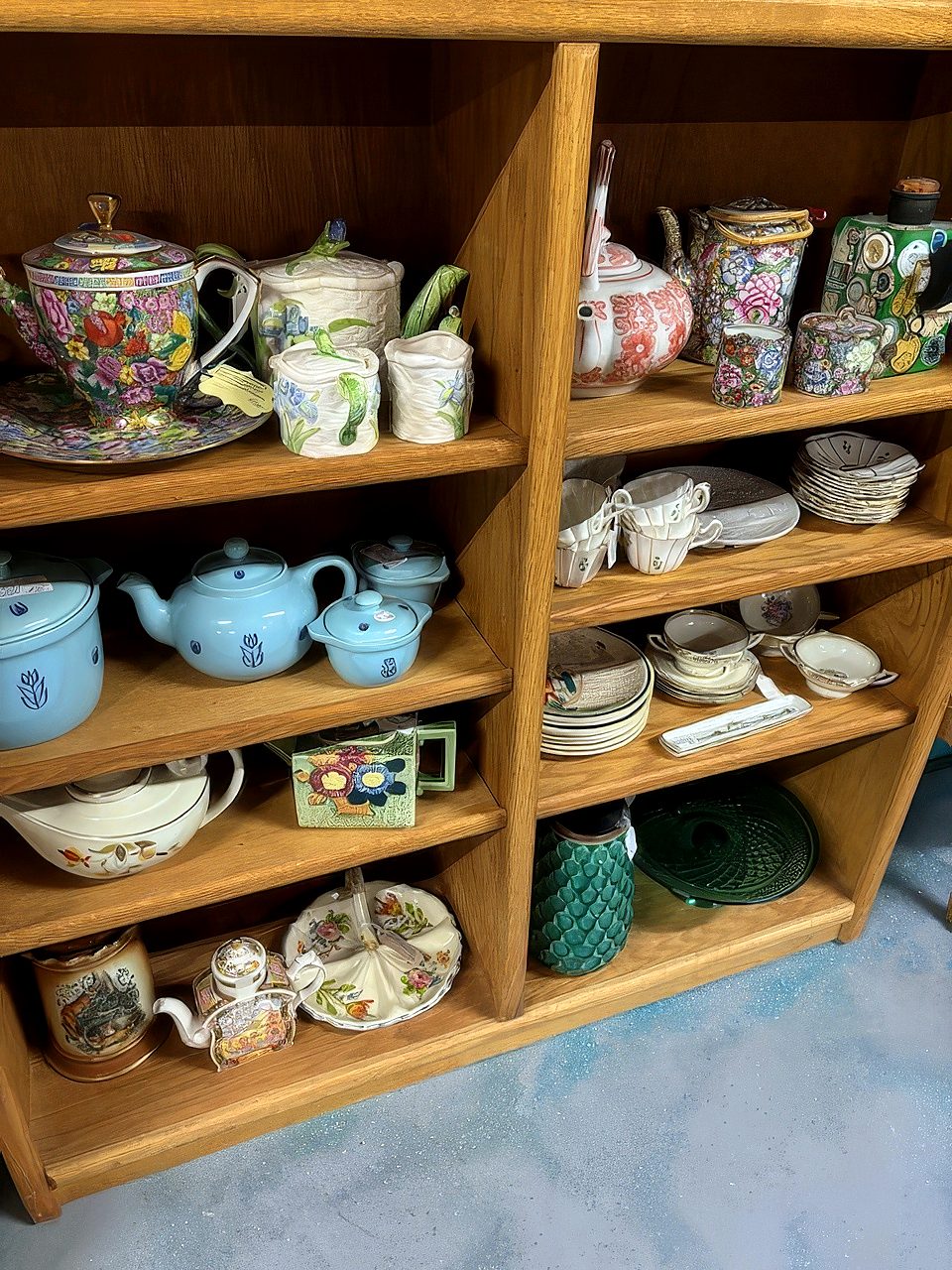
On our last look there were teapots, a blue tea set, and cups and saucers lined up on oak shelves. Booths change as vendors sell and restock, so we can't promise what's out today. That's the hunt.
- Start at the China tile in What's in the booths.
- Open the Treasure Map before you come. It shows the numbered booths, the display cases, the cashier at the entrance and the restrooms. There's an upstairs too.
- Hunting a match? Bring a photo of your pattern, front and backstamp, and compare as you go. Pattern-matchers, this is your stop.
- Questions about a piece? Ask at the cashier, or call (775) 461-3142.
Booth tip
Want to read a backstamp? Pick it up with both hands, over the case or a soft surface — and ask at the cashier if it's in a locked case. Every mark you read makes the next one easier.
More from the booths
-
Currency · How to collect
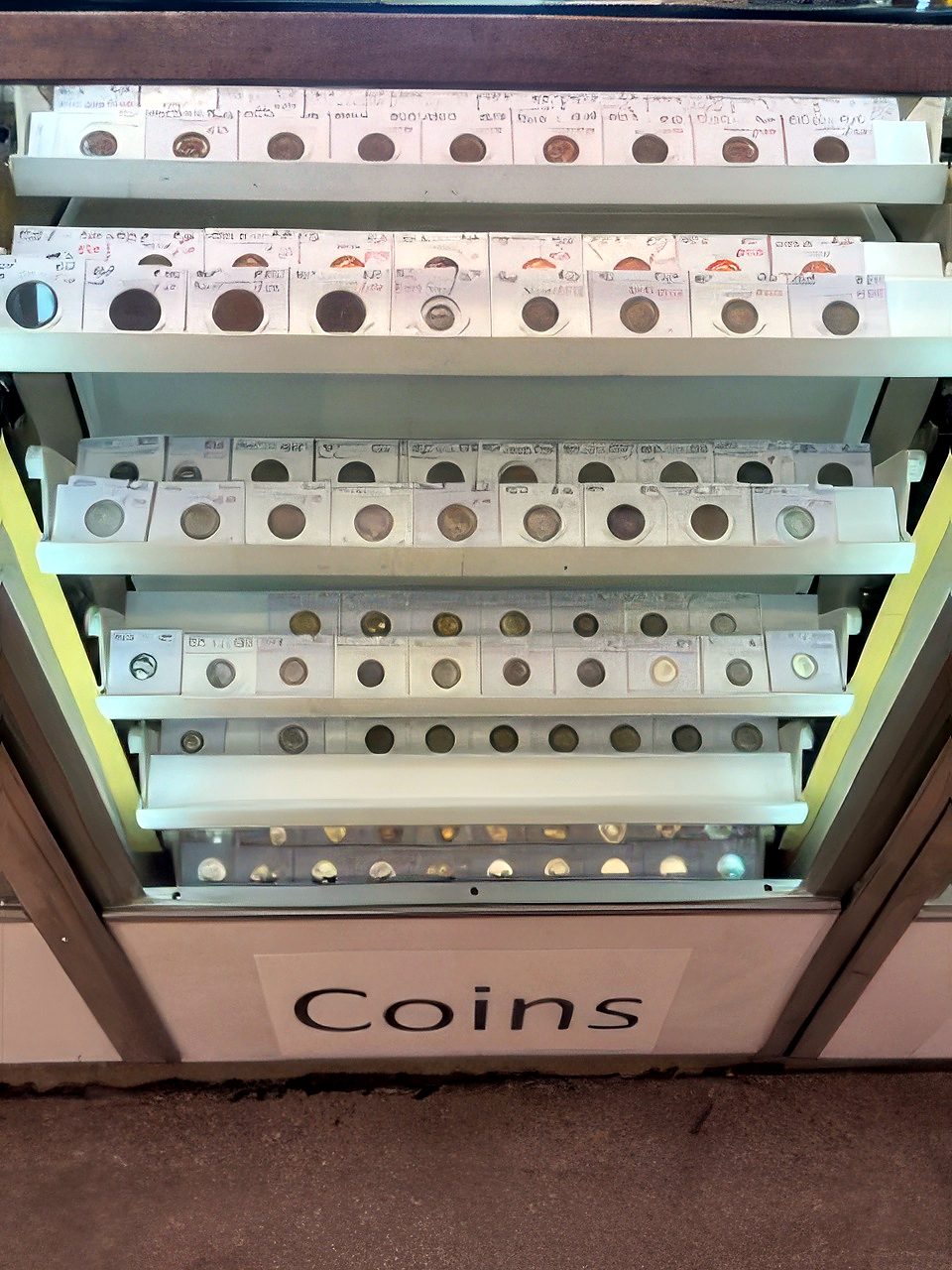
Start a coin collection
Silver dates, the 1–70 grading scale, and why you never clean a coin.
-
Collectibles · Real or repro
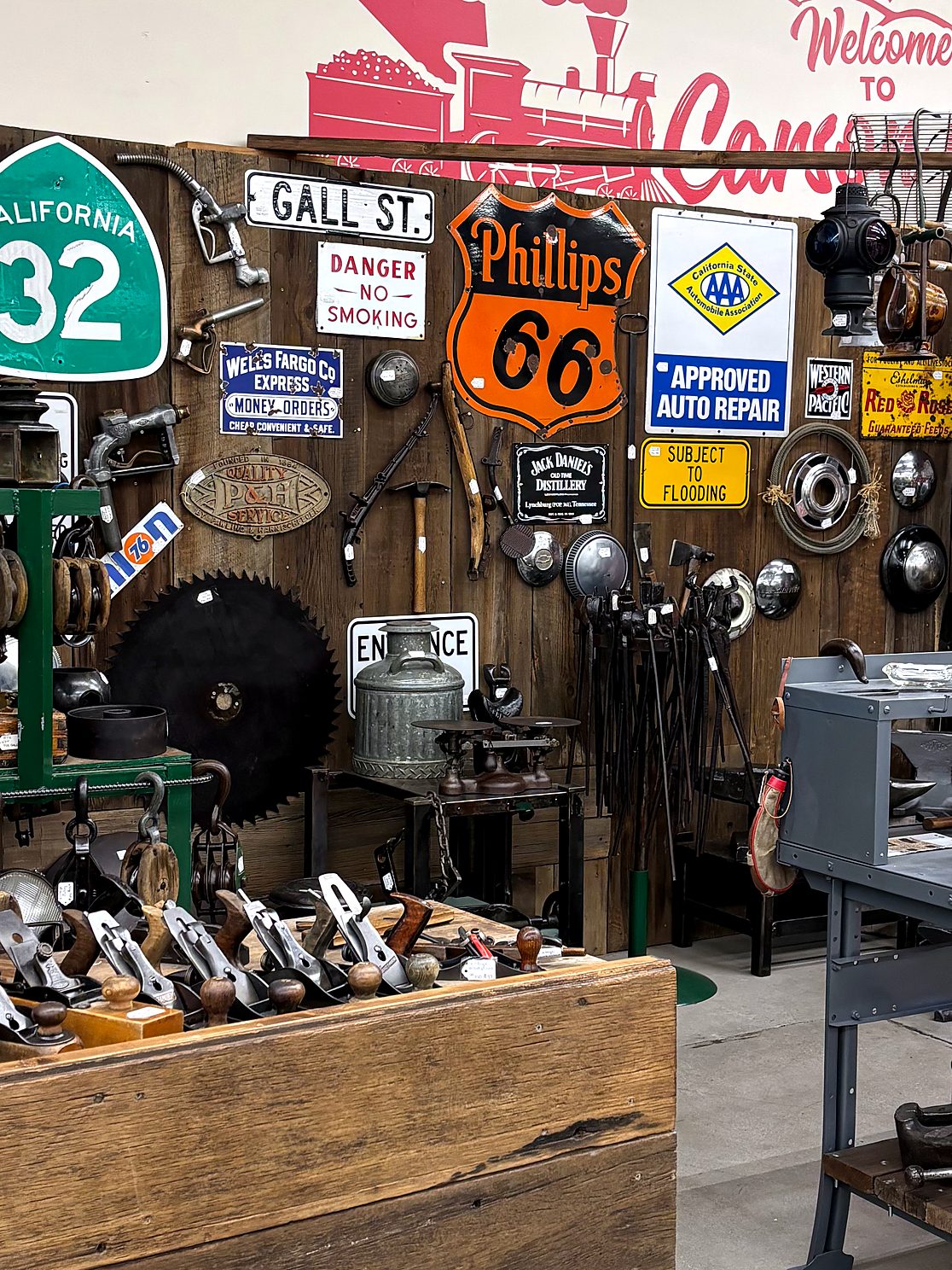
Spot a real vintage sign
Chips, rust, grommets and fake aging: a 5-minute check you can run in the booth.
Questions about old china
- Is old china worth anything?
- Some is, but most everyday dinnerware sells for less than people expect. Maker, pattern, age, condition, completeness and current demand set the number, so check sold prices to see where yours lands.
- What does “Nippon” on the bottom of a dish mean?
- “Nippon” is Japanese for “Japan.” Kovels dates Nippon-marked porcelain to 1891–1921; after that, pieces made for the U.S. were marked “Japan” or “Made in Japan.”
- How do I find my china pattern name?
- Photograph the front and the backstamp, then try Replacements' free Identification Tool (the camera icon in its search bar). If that misses, Replacements' researchers will try to identify it from your photos at no charge.
- Can vintage china go in the dishwasher or microwave?
- Replacements says older china should always be hand washed, because dishwasher racks can scratch and drying heat can loosen trim. Anything with gold or platinum trim should never go in the microwave.